Tribute to Peter Howden
RIP Peter Howden
This tribute was posted on Facebook on 19th January 2026 by Michael Brooke who worked with Peter at the Everyman from 1989 to 1995
Peter Howden (1945-2026) was about as far from a household name as it’s possible to imagine (a situation that I imagine suited him right down to the ground), but if you went to a London repertory cinema between the late 1960s and the late 1990s, the chances are that you either saw something programmed directly by him or something that was strongly influenced by an approach that he perfected at the Electric Cinema and went on to refine at the Everyman (back in the days when it was a one-off single-screen cinema in Hampstead). In particular, the Scala basically carried on doing in the 1980s what the Electric had already been doing for a decade or more.
He thought nothing of double billing Duck Soup with The Battle of Algiers, gave Ed Wood’s Glen or Glenda its first British theatrical run (in a double bill with Andy Warhol’s Bad), repeatedly championed classic Hollywood, arthouse cinema and grindhouse exploitation (one of my last jobs for him involved booking and marketing a twelve-film Russ Meyer retrospective), and somehow managed to keep his various venues running for years despite not receiving any support other than from the box office.
He’s also the major reason why I never bothered to get a formal film education, because with him as a full-time boss for six years, who needs a film degree? Pretty much everything I know about this business I first learned from him, and what I do now really isn’t that different from what I did back then; it’s still curating and contextualising outstanding, often neglected films, only via a different medium than the 35mm and 16mm prints that were my bread and butter in those formative years. And of the ten people shortlisted for what became my job, I gather that I was the least experienced by some distance but also had the strongest film knowledge, so he took a chance on me (“You won’t have learned any bad habits”), and I’m forever grateful that he did; I literally owe my career to him.
I always remember the thrill of him handing over his initial sketch for a bi-monthly programme, which would sometimes be extremely specific, and at other times vague (“Bresson triple”), and my job then would be to work out a combo of what would viably make money and what we hadn’t shown especially recently—my job was to be on top of what was currently in commercial distribution and keep it circulating. And sometimes—quite a bit of the time, gratifyingly—we’d put stuff on for the wholly selfish reason that one or both of us wanted to see it ourselves. In fact, I remember when we showed the seven-hour-plus Hitler: A Film from Germany, which unavoidably had to start in the afternoon—so I asked Peter if I could pop in and see it during my normal working hours, and he said “Yes, but you have to watch the whole thing, and I’ll be checking with the ushers.”
As that anecdote suggests, he had a wonderfully dry sense of humour—sometimes so subtle that it wasn’t immediately clear that he was joking. And some of my fondest memories of him involve things like him looking out of the window of my office that looked directly out onto the polling station in the 1992 general election and trying to guess which way people were voting. “Tory… possibly Labour… definitely Tory… no idea… oh my God, probably Rainbow Alliance.”
I only saw him twice this side of the millennium changeover, once when I casually bumped into him in Shaftesbury Avenue, much more recently at Cinema Ritrovato in Bologna in 2022, when I was delighted—albeit unsurprised—to see that he’d barely changed a bit; if he looked old for his age when I knew him in the 1990s (when he’d have been in the latter half of his forties), his late seventies suited him very well indeed, and it was great getting a belated chance to catch up. As anyone who knew him even slightly will attest, he was an ultra-private, very shy man, and therefore not the kind of person you could just ring up at random for a chat; he was quite happy for me to be the front man most of the time as regards communicating with the outside world, although sometimes his dodging of repeated phone calls from people he didn’t want to speak to became a tad farcical. Although I suspect he was fully aware of this and just wanted to see how hard they’d try.
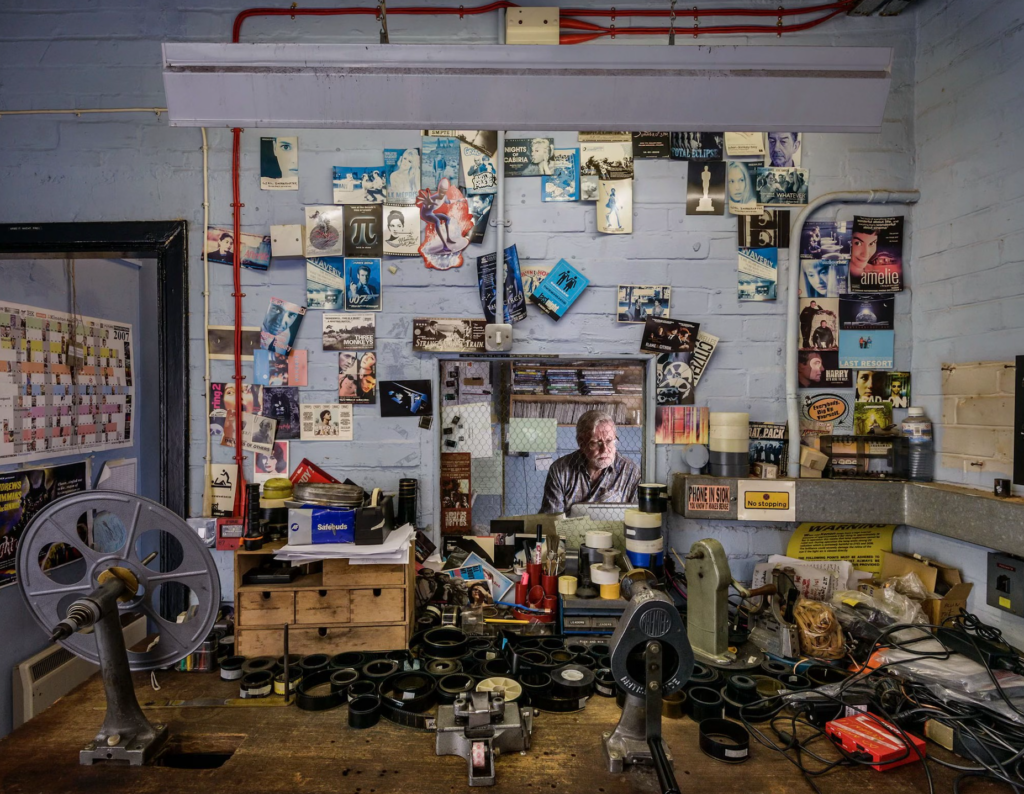
This photo by Richard Nicholson was taken in the Rio Cinema, where Peter ended up after leaving the Everyman in the late 1990s.